Service and emergencies · calls accepted from 7 AM to 11 PM
R.B.Q. 5840-4443-01 · CMMTQ Member · 514 917-5525
With 94,030 residents, Chomedey is the most populated area in Laval, and the one where collective housing carries the most weight: nearly two-thirds of dwellings are apartments, co-ownership reaches 29.8% compared to 18.2% for the city as a whole, and almost one in two households are renters, according to data from the CISSS de Laval.
This shifts the questions. Here, we are rarely asked which device to choose. We are asked who decides, who pays, and where the outdoor unit is allowed to go.
This is the first point to settle, even before talking about equipment.
| Situation | Who submits the application |
|---|---|
| Owner-occupant | The owner themselves |
| Rented unit | The building owner. The tenant is not eligible for a heat pump |
| Private portion in a co-ownership | The co-owner |
| Building with 19 units or less | Eligible |
| Building with 20 units or more | Eligible if the units have separate electricity meters |
Since November 26, 2025, the unit must be ENERGY STAR certified. The grant is calculated based on capacity at -8°C: $50 per 1,000 BTU/h, or $120 if the unit is ENERGY STAR Cold Climate certified. A $100 bonus per increment is added for multi-unit buildings for installations completed since June 15, 2026.
The company’s RBQ license number must appear on the invoice, along with the unit’s AHRI or ENERGY STAR number. Ours is 5840-4443-01. The application must be submitted within nine months following the installation.
Details of the conditions can be found in the LogisVert participation guide, and we summarize the essentials on our subsidies page. The most frequent reasons for refusal are detailed in this article.
Laval does not require any permit to install, move, or replace a heat pump. The location, however, is regulated: articles 265 and 266 of the Urban Planning Code set the authorized yards and distances to be respected, and the City penalizes non-compliant installations with a $400 fine for an individual and $1,000 for a legal entity. Water-cooled air conditioners are prohibited throughout the territory.
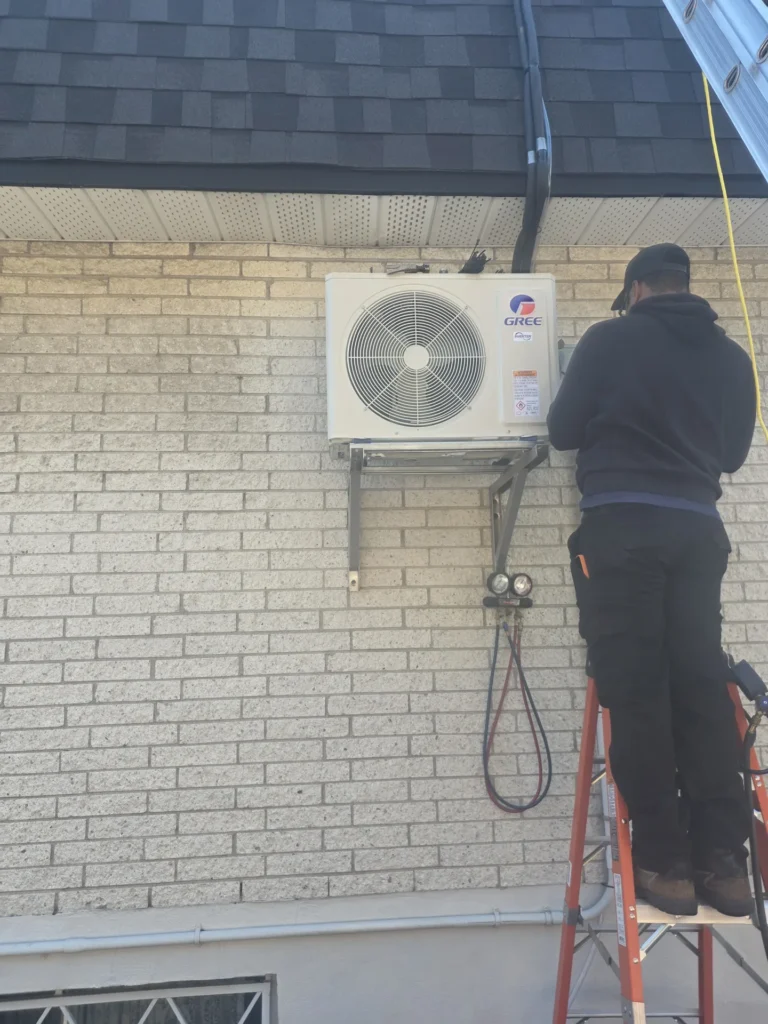
On a plex lot designed for a single house, three outdoor units cannot be placed at random. We select locations that remain accessible for annual cleaning and that do not face a bedroom window, whether yours or the neighbor’s.
Bylaw L-12423 caps outdoor noise at 55 dB(A) between 7 a.m. and 9 p.m., and at 50 dB(A) at night. A compressor with a tone that stands out from the background noise has an additional 5 dB(A) deducted from the limit. The measurement is taken more than three meters from a wall, between 1.20 m and 1.50 m from the ground.
One detail changes everything in collective housing: the bylaw exempts a building’s mechanical systems when the noise is perceived on the grounds of that same building. Your own unit cannot be used against you. The neighbor’s can be, as soon as it is heard in your home.
This is why we check the noise level of the selected unit before installation, not after a complaint.
Nearly half of Chomedey’s housing stock was built before 1980. These electrical services have not all been updated since. Three additional units cannot be added automatically, and the verification is done before the quote, not the morning of the installation.
When several closed rooms need to be treated without multiplying outdoor units, the Gree Freematch multi-zone connects two to five indoor units to a single compressor, with operation rated down to -30°C. For a single dwelling, a simple wall-mounted heat pump is usually sufficient.
Chomedey is part of the territory we serve in Laval.
No. Laval does not require any permit, but the location must comply with articles 265 and 266 of the Urban Planning Code. A non-compliant installation is subject to a $400 fine for an individual.
No. For a heat pump, the building owner submits the application. A tenant can only do so for certain appliances, such as an induction cooktop or a heat pump dryer.
Yes, if the units have separate electricity meters. Without separate meters, the threshold is 19 units.
The thresholds are 55 dB(A) during the day and 50 dB(A) at night, measured more than three meters from a wall. If the unit emits a distinct tone, 5 dB(A) is deducted from the applicable threshold.
We’ll come to you, take measurements, and explain what works best and why. Then, you decide.