
Service and emergencies · calls accepted from 7 AM to 11 PM
R.B.Q. 5840-4443-01 · CMMTQ Member · 514 917-5525
Detached from Saint-Martin in 1869, Sainte-Dorothée first lived off truck farming before becoming Quebec’s largest concentration of greenhouse flower producers. Its population tripled during the 1950s, and the sector hasn’t stopped building since: within its planning area, nearly one in four homes dates from 2001 to 2010, the highest proportion in Laval. The old core, meanwhile, was organized around the 1873 church designed by Victor Bourgeau.
Two very different types of projects stem from this dual heritage: correctly sizing new, airtight homes, and intervening carefully in a heritage sector.
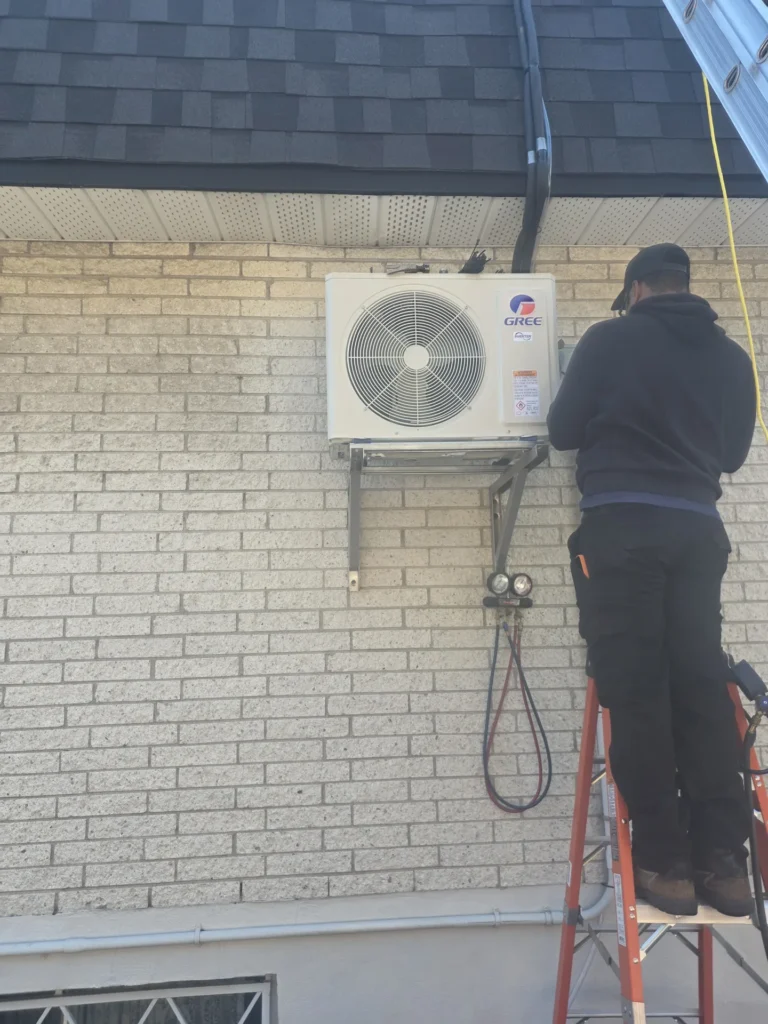
The quick quote reflex consists of applying a BTU-to-square-foot ratio. On a home from the 2000s, it almost always leads to oversizing.
An oversized unit reaches the setpoint too fast, stops, and restarts. These short cycles have two consequences. In summer, the airflow is too brief to dehumidify: the house reads 73 °F but stays clammy. Year-round, the compressor takes a series of starts and wears out prematurely.
The calculation is based on the building envelope: orientation, window surface, insulation, airtightness, actual heated volume, and partitioning. Two houses of identical size, one from 1968 and the other from 2006, do not require the same power. This is also what often decides between wall-mounted and central units.
A house that lets little air through doesn’t refresh itself. The fog that settles at the bottom of windows in January isn’t an excess of moisture being produced: it’s moisture that can no longer get out.
In recent homes, the cause is mechanical much more often than it is climatic. An air exchanger never started when the house was delivered, left in recirculation mode, filters never replaced, or a blocked outdoor air intake. The heating system has nothing to do with it, and changing the unit won’t fix the problem.
We check the state of the ventilation before proposing a system, because a new unit installed in a house that doesn’t breathe only moves the symptom. The subject is covered in detail on our air treatment and indoor air quality pages.
Sainte-Dorothée is one of Laval’s eight heritage territories, and one of five urban sectors subject to a Site Planning and Architectural Integration Program (PIIA) since 1997.
The nuance is important. In a standard sector, an installation that complies with regulations is authorized by right. Under a PIIA, interventions visible from the public right-of-way are subject to a discretionary, case-by-case evaluation. A technically perfect location can be refused for architectural integration reasons.
Before finalizing a front-facing position in this perimeter, we validate with the Urban Planning Department rather than assuming. This adds a few days but avoids a complete redo.
| Point checked | What’s at stake |
|---|---|
| Envelope and airtightness | The actual power to install, and therefore the price and lifespan of the unit |
| Ductwork | Size, joint sealing, and balance between floors. Installed capacity never reaches the rooms if the network can’t handle it |
| Ventilation | A non-functional air exchanger skews the humidity diagnosis |
| Electrical panel | Available capacity may exclude certain models |
| Outdoor location | Authorized yards, access for annual maintenance, and PIIA approval in the village core |
When the ductwork exists and is sound, a central heat pump is the most logical path. We confirm the ENERGY STAR or AHRI number of the exact model before quoting: since November 26, 2025, without this certification, there is no LogisVert assistance.
Sainte-Dorothée is part of the territory we serve in Laval.
Not necessarily. The network must first be in good condition: sufficient size, sealed joints, and correct balance between floors. A deficient network cancels out the advantage of a central system, and a multi-zone wall-mounted unit then becomes the best option.
Because power is calculated based on the envelope, not the square footage. A figure given without seeing the house is a figure that will be revised.
The heritage territory perimeter is defined by the City. We check with the Urban Planning Department before setting a location visible from the street.
We’ll come to you, take measurements, and explain what works best and why. Then, you decide.