
Service and emergencies · calls accepted from 7 AM to 11 PM
R.B.Q. 5840-4443-01 · CMMTQ Member · 514 917-5525
Deux-Montagnes Zoning Bylaw No. 1733 contains a provision that many installers overlook: how the distance between accessory equipment and the property line is measured. It can disqualify a location that seemed compliant with a tape measure.
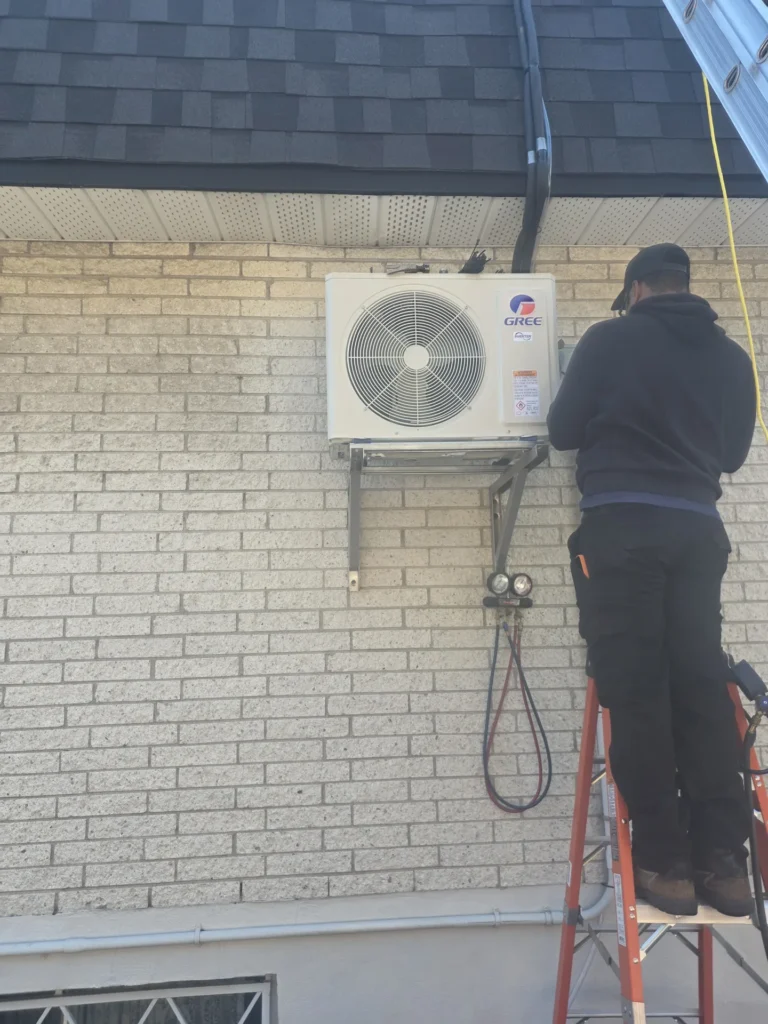
Article 29 of Bylaw 1733 states that, for accessory equipment, the distance is measured horizontally from its base or supporting structure, or from the ground projection of its furthest edge when it extends beyond the base.
In practical terms: an outdoor unit placed on a wall bracket or pads, where the cover extends past the base, is measured from the furthest point of the cover. A few inches are enough to make an installation non-compliant. This also applies to protective snow grilles installed after the fact.
| Provision | Subject |
|---|---|
| Article 147 and Table 5 | Location of a heat pump, air conditioner, and generator |
| Articles 108 and 109 | Mechanical equipment, tanks, air conditioners, generators, rooftop solar panels, and rooftop terraces |
| Article 77, par. 4 a) | General rule for accessory equipment: up to 6 m³ and 1.5 m in height in all yards, unless otherwise specified |
| Article 29 | Distance measurement method |
Table 5 is the reference that sets, yard by yard, what is permitted and at what distance. Article 77 does not change this: it is superseded as soon as a specific provision exists, and Article 147 is one. We check the table for your specific zone during the site visit, because the land use and standards grid can tighten general rules depending on the sector.
Article 66 of Bylaw No. 1735 concerning permits and certificates classifies mechanical system overhauls, including heating, as maintenance and repair work, which do not require a permit as long as the building’s appearance is not significantly altered.
Adding a unit where there was none falls under the “renovation or improvement” category of Table 1. The distinction isn’t just theoretical: it determines whether documents must be filed before work begins, as required by Article 24.
Deux-Montagnes borders the Lake of Two Mountains. This has two consequences for an outdoor unit. The first is the floodplain: in waterfront sectors, the height of the base isn’t a matter of preference; it’s a floodproofing measure. The second is corrosion: high humidity near the water accelerates wear on the outdoor unit’s fins and hardware.
We systematically elevate the base in these sectors and prioritize equipment with documented anti-corrosion treatment. Annual maintenance is more important here than elsewhere: rinsing the outdoor coil every spring changes the lifespan of the unit.
It is set in Table 5 of Zoning Bylaw No. 1733, which establishes it yard by yard. We check the table for your zone during the site visit rather than quoting a single figure that would be wrong half the time.
According to Article 29, horizontally from the base of the equipment, or from the ground projection of its edge if it extends beyond the base. An overhanging cover therefore counts in the measurement.
Article 66 of Bylaw 1735 considers a heating system overhaul as maintenance, which does not require a permit if the building’s appearance is not significantly altered. A first-time installation falls under a different category: we verify this before starting work.
Yes. An elevated base in flood-prone sectors and annual rinsing of the outdoor coil, because the humid lake air accelerates corrosion.
Saint-Eustache, Boisbriand, Rosemère, Lorraine, and Bois-des-Filion, among others. The full list is on our service areas page.
We’ll come to you, take measurements, and explain what works best and why. Then, you decide.