
Service and emergencies · calls accepted from 7 AM to 11 PM
R.B.Q. 5840-4443-01 · CMMTQ Member · 514 917-5525
Blainville has the most consistent housing stock of the three North Shore cities we serve. Nearly half of its 22,424 homes were built between 1991 and 2010, and barely 3% date back to before 1960. It is also the city with the highest homeownership rate in the sector, at nearly 78%.
This profile has a direct impact on our work: the units installed when these houses were built are now reaching the end of their lifespan, all at roughly the same time.
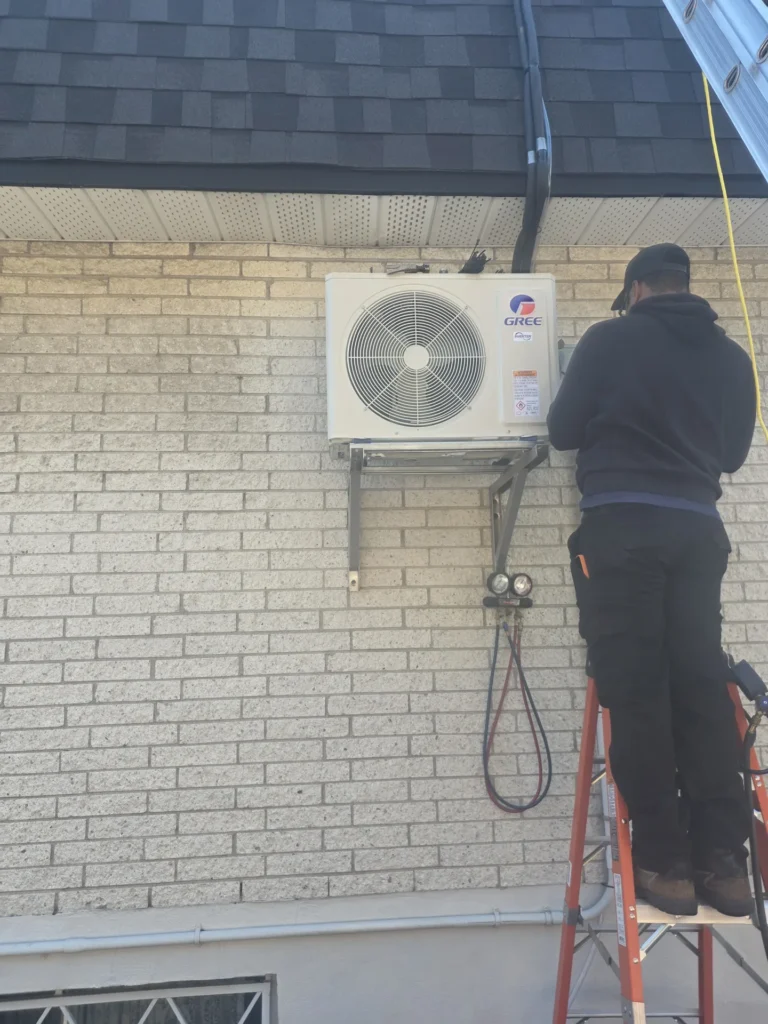
This is the most concrete difference compared to neighboring cities.
Section 91 of Zoning Bylaw 1418 states it in black and white: a heat pump, air conditioning system, or any similar equipment must be camouflaged by a screen so as not to be visible from the street. This isn’t an integration recommendation; it’s a condition for authorization.
Two useful nuances: An air conditioner installed in a window or another wall opening is exempt from the rule and remains permitted in all yards. And the front yard is off-limits: the unit must go in the side or back yard.
| Yard | Heat pump and air conditioning |
|---|---|
| Front yard | No |
| Side yard | Yes, with screen |
| Backyard | Yes, with screen |
We include the screen in the quote rather than leaving it for you to handle afterward. Its position dictates the unit’s placement, not the other way around: a poorly placed screen chokes airflow and causes performance to drop.
There is some confusion circulating in Blainville, and it comes from the bylaw itself.
The same Section 91 imposes a minimum distance of 1.5 meters from any property line, but only for pool equipment: pool heat pumps, filtration systems, and similar equipment. For a residential heating or cooling heat pump, no minimum distance is prescribed, and no maximum height either.
An installer who tells you 1.5 meters is mandatory for your heating unit is applying the wrong line of the table. This could make you give up a perfectly compliant location or pay for an unnecessary relocation.
Bylaw 1453 concerning noise prohibits any noise where the level, perceived beyond the limits of the property from which it originates, exceeds 55 dB(A). Zoning uses the same threshold for heat pumps.
The measurement point changes everything. It’s not the level one meter from the unit that counts; it’s what crosses your property line. A compressor placed against a reflective wall, or in a narrow corridor between two houses, carries much further than the spec sheet suggests.
There is also a time-based rule: between 11 p.m. and 7 a.m., noise originating from inside a building that is audible outside the property limits is prohibited. Fines start at $200 for individuals.
On the other hand, there’s good news: Blainville’s bylaw on site planning and architectural integration programs (PIIA) only applies to main buildings, their expansions, and certain accessory structures. A residential heat pump is not subject to it.
When a house dates back to 1998 and the unit is the one installed by the builder, two things have changed since then.
First, efficiency: a unit from that generation has nothing in common with today’s cold-climate heating technology. Second, sizing: your house may have been expanded, the basement finished, or windows replaced. The original power rating is no longer necessarily the right one.
That’s why we recalculate the load on the building envelope rather than just using the tonnage of the old unit. When the ductwork exists and is in good shape, a central heat pump remains the most direct route. For a finished basement, a room above the garage, or an addition that the main system doesn’t reach, a multi-zone wall unit solves the problem without rerouting the network.
Regarding subsidies, the unit must be ENERGY STAR certified as of November 26, 2025, and our RBQ license number must appear on your invoice. Details are on our subsidies page. Blainville is part of the territory we serve.
Yes. The zoning bylaw requires it so that the unit is not visible from the street. Only air conditioners installed in a window are exempt.
The municipal fact sheet on heat pumps doesn’t mention one, and the administrative bylaw doesn’t require them. We confirm this with the Urban Planning Department at the time of the quote.
No distance is prescribed for a heating or cooling heat pump. The 1.5 meters often cited only applies to pool equipment. The real constraint is the 55 dB(A) threshold at the property line.
We’ll come to you, take measurements, and explain what works best and why. Then, you decide.