Service and emergencies · calls accepted from 7 AM to 11 PM
R.B.Q. 5840-4443-01 · CMMTQ Member · 514 917-5525
Mirabel covers 484 km², three times the size of Terrebonne and nearly nine times that of Blainville. Its population grew by 21% between 2016 and 2021, and nearly four out of ten homes there have been built since 2011. It is by far the newest housing stock in the North Shore.
This rapid growth explains a unique feature: Mirabel is the only city we serve that specifies exactly where to install an outdoor unit. Where Terrebonne and Blainville remain silent on distances, Mirabel provides specific measurements in meters.
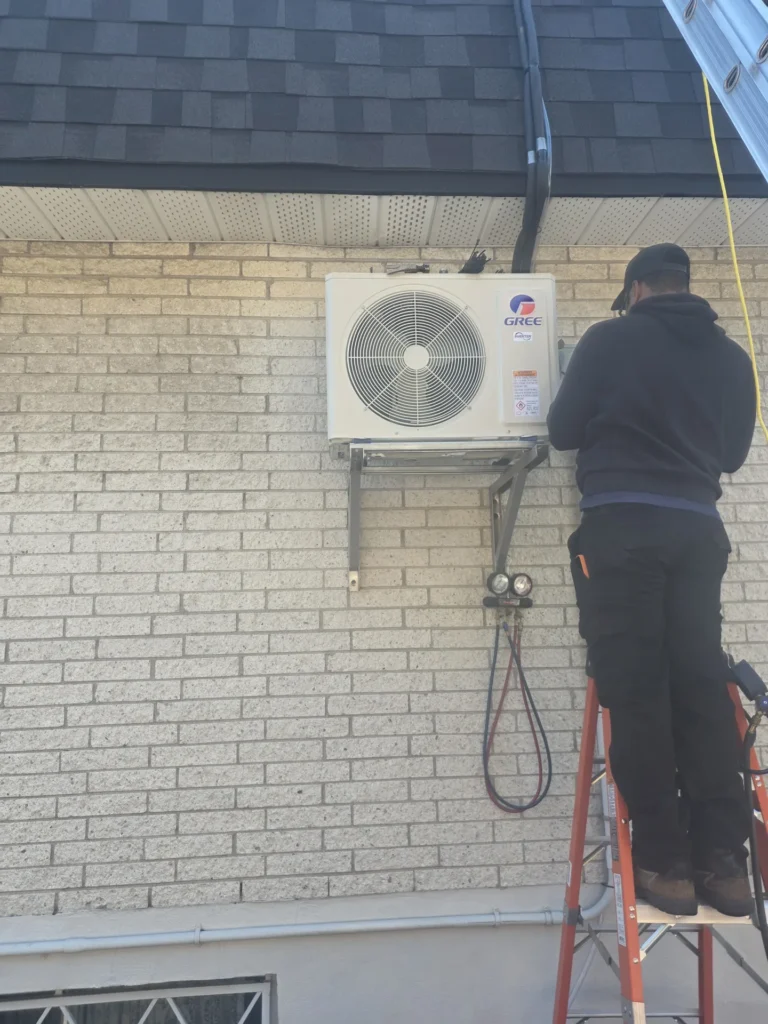
Section 6.2.30 of Zoning Bylaw U-2300 is the most detailed of the three cities. No permit is required, but the installation standards leave no room for interpretation.
| Situation | Standard |
|---|---|
| Distance from a property line | 2 m |
| With absorbent acoustic screen | 1 m |
| Property line, semi-detached or row house | 0.5 m, with an opaque screen at least 2 m long |
| Side yard | Starting from the second half of the building’s depth |
| Front yard | Only under a concrete balcony, not visible from the public right-of-way |
| Back Yard | Authorized |
| Maximum screen height | 3 m |
| Noise | 50 dB at the property line |
And one rule that overrides everything else: under no circumstances can a heat pump be visible from the public right-of-way.
These numbers are not just for show. Moving from 2 meters to 1 meter from a property line on a narrow lot often determines the very feasibility of the project.
This is the most frequent mistake in Mirabel, and it is explicitly anticipated by the bylaw: trees, shrubs, and lattices are not considered acoustic screens.
The screen must be absorbent. A cedar hedge, no matter how dense, does not give you the right to go down to one meter from the property line. Neither does a decorative wooden lattice.
We take this into account during the site survey, because the difference is paid for twice: first by having to move the unit, and then in fines. Fines for urban planning bylaw violations range from $200 to $1,000 for individuals and increase with each repeat offense.
Bylaw 690 concerning nuisances sets the limit at 50 dB(A) at the property line of the building where the noise originates. This is the strictest threshold of the three cities: Blainville allows 55 dB(A) at the same measurement point.
Specific time slots also apply: noisy devices are prohibited from 8 p.m. to 7 a.m. Monday through Friday, and from 7 p.m. to 8 a.m. on Saturdays and Sundays.
A five-decibel difference from Blainville seems small. On the logarithmic scale of noise, this reduces the allowable sound energy by half. In practical terms, a model that passes in Blainville won’t necessarily pass in Mirabel, which is one more reason not to transpose a quote from one city to another.
Across 484 km², the name “Mirabel” covers very different types of projects.
In the recent developments of Saint-Janvier, Domaine-Vert, or Mirabel-en-Haut, houses are airtight and often equipped with a duct network. Air conditioning integrates into the existing system, and the real issue becomes ventilation: a new house does not renew its air on its own, and an air exchanger that is poorly adjusted or never turned on is the primary cause of fogged windows in January. This is the realm of air treatment.
In village sectors and along Saint-Jacques and Saint-Augustin streets and Saint-Canut Boulevard, the bylaw on site planning and architectural integration programs (PIIA) applies: interventions are evaluated on a case-by-case basis, and the camouflaging of mechanical equipment is part of the criteria.
Along the rural roads, houses are older and often have large volumes. The location of the outdoor unit requires more attention than elsewhere: prevailing winds, snow accumulation, and distance to the electrical panel.
For commercial and agricultural buildings, rooftop units and higher-capacity systems dominate, with a greater emphasis on preventive maintenance than in residential settings. Mirabel is part of the territory we serve.
No. The City’s information sheet explicitly states this. However, the installation standards of section 6.2.30 of the zoning bylaw still apply.
No. The bylaw specifically excludes trees, shrubs, and lattices. Without an absorbent screen, the minimum distance remains 2 meters.
Only if it is installed under a concrete balcony and is not visible from the public right-of-way. This is the only exception allowed for front yards.
Often, yes. An absorbent acoustic screen reduces the minimum distance from 2 meters to 1 meter, and to 0.5 meters along a property line for a semi-detached or row house. This is exactly what we look for during the site survey.
We’ll come to you, take measurements, and explain what works best and why. Then, you decide.