Service and emergencies · calls accepted from 7 AM to 11 PM
R.B.Q. 5840-4443-01 · CMMTQ Member · 514 917-5525
The Flexx R32 isn’t a wall-mounted unit: it’s a central heat pump connected to a duct network. This is the line we install when the building is already ducted and the owner wants to treat the air for the whole house, not room by room. It is also the only Gree line we can pair with a gas furnace for dual-fuel heating.
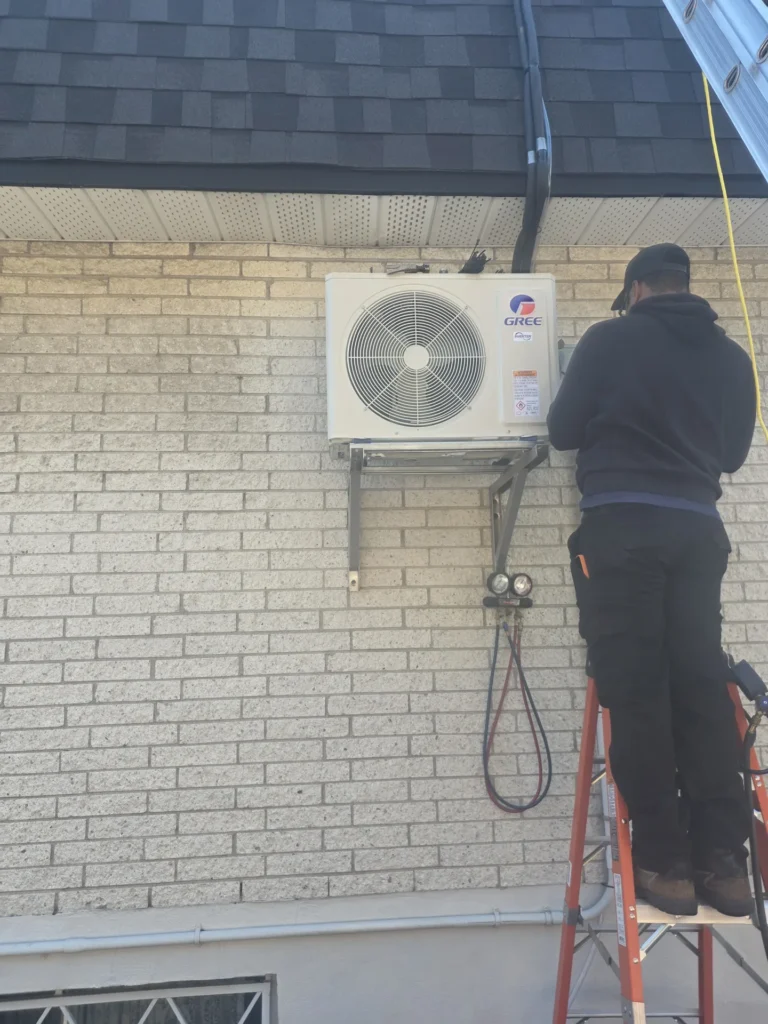
In a home already equipped with ducts, the Flexx replaces the outdoor A/C unit and, depending on the setup, the heating source. The plenum, ducts, and grilles stay in place. Air flows horizontally through the side of the indoor unit, allowing for installation in low-ceiling basements or attics where a vertical-flow unit wouldn’t fit.
The benefit of this setup goes beyond temperature. Since all the air in the house passes through the same unit, you can add filtration, humidification, dehumidification, and a UV lamp: the entire air quality aspect becomes accessible all at once. A wall-mounted unit, by contrast, only treats the air in the room where it’s installed.
| Data | Value |
|---|---|
| SEER2 | up to 19 |
| HSPF2 | up to 10.5 |
| Cooling Range | −15°C to 54°C |
| Heating Range | −30°C to 24°C |
| Maximum Line Length | 50 m |
| ENERGY STAR | yes |
| Control Power | 24 VAC |
| Outdoor Sound Level | as low as 63 dB(A) |
Heating goes down to −30°C, just like the Airy, Clivia, and Multi-zone wall units. That’s the key figure for a North Shore winter: the unit doesn’t quit on the coldest nights in January.
The Flexx is controlled via 24 VAC, the voltage used by conventional thermostats. In practice, a furnace thermostat already on your living room wall can stay, and off-the-shelf smart thermostats work without a gateway. This is the opposite of wall units, which are controlled by their own remote or app.
Certain configurations also accept an RS485 connection to the indoor unit. We determine this during the site assessment, as it depends on the exact model and the existing wiring in the house.
Two variants exist in the line. The Ultra Heat version boosts heating performance in extreme cold. The Dual Fuel version is designed to work alongside a natural gas furnace: the heat pump handles the heating as long as the outdoor temperature remains cost-effective, then the control switches to gas when the cold makes the furnace more economical.
This is the setup we recommend for homes already connected to natural gas. It avoids scrapping a furnace that’s still good and reduces peak electricity bills. The switch-over point is set during installation, based on electricity rates and gas prices.
Standard 10-year warranty. Additional 2-year warranty with Wolseley when the product is registered or proof of installation is provided, for a total of 12 years on parts.
Assessments and quotes are free: email us or call 514 917-5525.
Yes, that is exactly what the Dual Fuel version allows. The heat pump heats during mild and moderately cold weather, and the furnace takes over below the switch-over point set during installation.
If it’s a conventional 24 VAC thermostat, generally yes. We check the wiring during the site assessment before confirming, because the number of available wires in the wall determines what we can control.
Not systematically. We measure the airflow the existing network can handle and compare it to what the chosen unit requires. An undersized network is noisy and heats poorly: if it needs to be modified, we’ll tell you before the work starts.
Down to −30°C according to the manufacturer’s spec sheet. Efficiency drops as it gets colder—that’s true for any heat pump—but the unit does not stop running.
If the house already has ducts, a central system is almost always the best choice: one single unit, one maintenance schedule, and air treatment for the whole house. If there are no ducts, a multi-zone setup avoids major construction work.
We’ll come to you, take measurements, and explain what works best and why. Then, you decide.