
Service and emergencies · calls accepted from 7 AM to 11 PM
R.B.Q. 5840-4443-01 · CMMTQ Member · 514 917-5525
1858. Sainte-Rose was incorporated as a municipality and remained the only urban municipality on Île Jésus for fifty-four years. Montrealers began building summer residences there in the 1880s: by 1941, vacationers still accounted for 44% of the population.
This history is written in the walls. The city’s architectural heritage inventory lists traditional Quebec houses from 1840 to 1890, vernacular cottages and Four Squares from 1900 to 1930, and vacation architecture from the 1940s. Surrounding this core are post-war suburbs and recent developments.
Installing a heat pump in Sainte-Rose starts with a question you don’t ask anywhere else in Laval: what era is the building from, and is it protected?
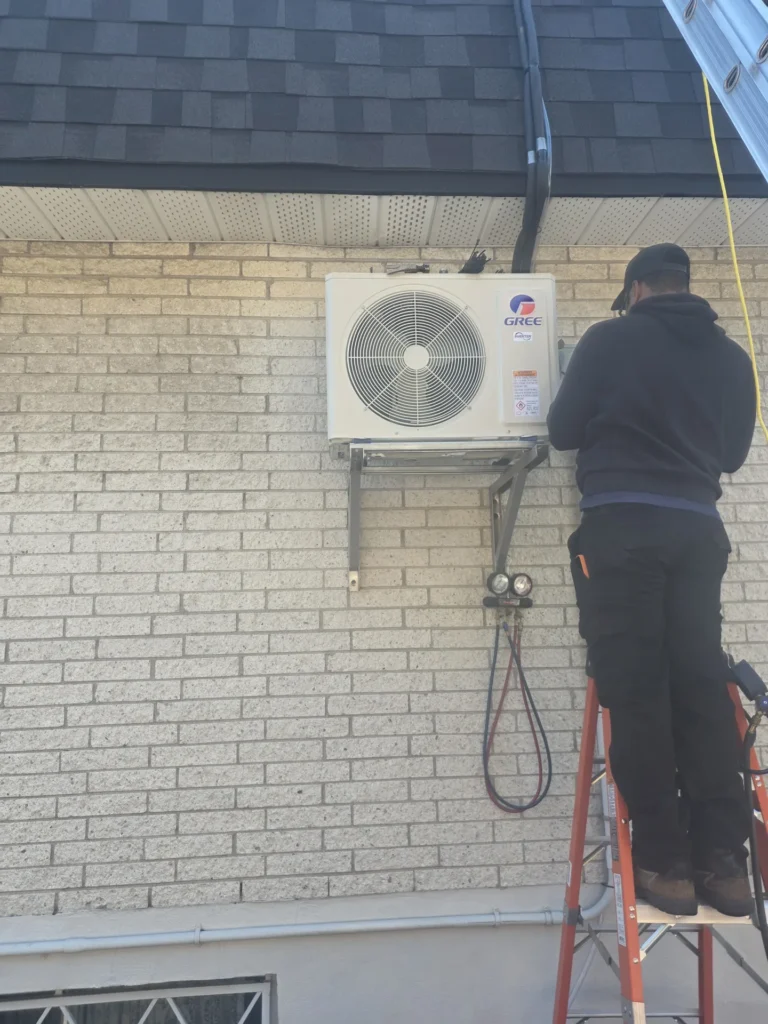
In 2019, Laval adopted two bylaws, L-2001-3641 and L-12659, which protect 102 buildings located outside recognized heritage zones.
This is the point most homeowners miss. You can live several streets away from the old village, think you’re outside any perimeter, and discover after the fact that your house is on the list. Checking takes a few minutes. Redoing a rejected installation costs significantly more.
Old Sainte-Rose, for its part, is one of Laval’s eight heritage areas and has been subject to a PIIA since 1997: interventions visible from the street are approved on a case-by-case basis. As for the Sainte-Rose-de-Lima church, it has been classified as a heritage building since October 19, 2012, a protection that covers the building, inside and out, rather than the land.
The unit is never the problem in older buildings. It’s what surrounds it.
Solid brick masonry, timber framing, stone: drilling the refrigerant line and fixing the bracket must be planned with an on-site layout. The cornice and roof overhangs often dictate the possible height of the wall bracket. And the electrical service of a building from this era is frequently limited: available capacity determines the model, never the other way around.
Since ductwork is rarely present, wall-mounted heat pumps remain the most common answer. The Airy from the Gree R32 line is rated up to 30.0 SEER2 depending on capacity, 28.0 on the 12,000 BTU model, with heating down to -30°C.
The logic reverses just a few hundred yards away. Common ductwork, a tighter envelope, decent insulation: central heat pumps become the most direct route again, and the focus shifts to the condition of the ducts and ventilation.
A note of caution on rebates. Since November 26, 2025, LogisVert has required ENERGY STAR certification. A certified product line isn’t necessarily certified across all capacities: we confirm the ENERGY STAR or AHRI number of the exact model before quoting, rather than finding out at the time of the application.
| Era | What we check, and the most frequent solution |
|---|---|
| 1840-1900 | Heritage status, wall type, electrical service. Wall-mounted, single or multi-zone |
| 1900-1940 | Heritage status, cornices and overhangs, panel. Multi-zone wall-mounted |
| 1950-1980 | Insulation, presence and condition of ducts, panel. Wall-mounted or central depending on ductwork |
| After 1990 | Airtightness, duct balancing, ventilation. Central |
The evaluation is done on-site, never over the phone. We don’t propose the same system on both sides of the boulevard, and that’s normal: they aren’t the same houses. Sainte-Rose is part of the territory we serve in Laval.
Yes. The sector is subject to a PIIA, which means interventions visible from the public right-of-way are evaluated on a case-by-case basis rather than being permitted by right. The location is validated with the Urban Planning Department before installation.
The lists are annexed to bylaws L-2001-3641 and L-12659 adopted in 2019. We perform the check during the evaluation before selecting a location.
Yes. That is exactly what wall-mounted units are for. For multiple closed rooms, a multi-zone system connects two to five indoor units to a single outdoor unit.
Laval’s noise bylaw sets limits at 55 dB(A) during the day and 50 dB(A) at night, with a 5 dB(A) reduction if the device emits a distinct tone. The sound level of the selected model is verified before installation.
We’ll come to you, take measurements, and explain what works best and why. Then, you decide.