
Service and emergencies · calls accepted from 7 AM to 11 PM
R.B.Q. 5840-4443-01 · CMMTQ Member · 514 917-5525
Of the eight cities we cover north of Laval, Bois-des-Filion is the only one to completely close off the front of the lot. Not the front yard, not the front setback, and not even the secondary front yard of corner lots: the zoning bylaw’s accessory equipment table lists No three times in a row. The unit therefore goes in the back or on the side, five feet (1.5 m) from the property lines.
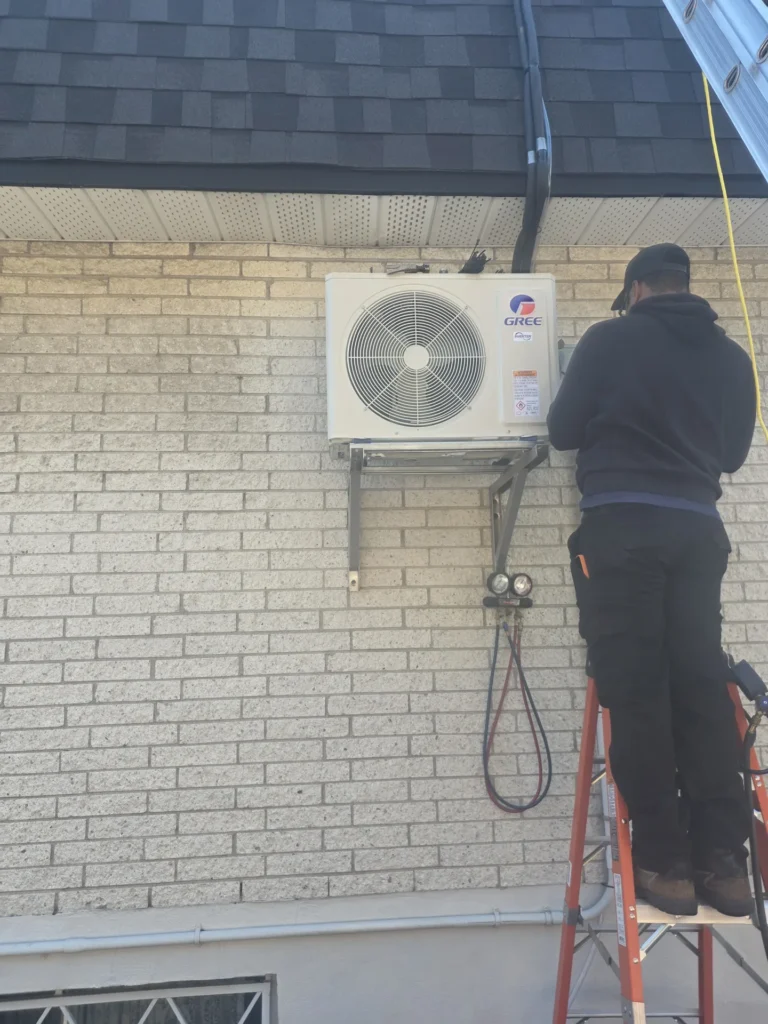
Zoning Bylaw No. 7200, adopted January 15, 2018, and in effect since March 17, 2018, groups heat pumps in a common table with generators, tanks, and cylinders. Line 5 of this table reads as follows.
| Location | Authorized | Minimum distance from property line |
|---|---|---|
| Front yard | No | — |
| Front setback | No | — |
| Secondary front yard | No | — |
| Side yards and setbacks | Yes | 1.5 m |
| Rear yard and setback | Yes | 1.5 m |
The restriction on the secondary front yard is the unique part. In Saint-Eustache, a corner lot can house its unit on the side facing the cross street; here, it can’t. On a narrow corner lot, this immediately removes half of the possible locations, and the issue is settled before buying the unit, not on installation day.
The bylaw is precise on this point: when one of these units is installed permanently in side yards, it must be hidden by opaque landscaping, so as not to be visible from the street.
The text says “landscaping,” not “screen” or “fence.” A dense hedge, a cluster of evergreen shrubs, or a structured planting meets the letter of the law. A hastily installed lattice panel does not.
The resulting technical constraint is always the same, and it is underestimated. An outdoor unit must discharge its air freely; a cluster planted too tightly sends its own air back into it, which drives up consumption in summer, causes faster icing in winter, and wears out the compressor. Clearance is calculated before planting. This is exactly the work we do upstream of a ductless heat pump installation.
Bois-des-Filion lives with two highway axes, and its bylaws draw conclusions that few neighboring cities formalize. Along the targeted sections, so-called sensitive uses—residential, education, health, childcare—are subject to a special regime.
New construction is prohibited there unless a noise pollution study conducted by an engineer specializing in acoustics accompanies the application. This study must demonstrate that mitigation measures bring the noise level below 55 dBA over a 24-hour period, measured inside the building, supported by plans and specifications.
When a noise barrier is the chosen solution, the bylaw dictates the specs: a highway-style screen, made of concrete and aggregate on a concrete foundation, ensuring the maximum level does not exceed 45 dBA, with certification from an acoustic engineer who is a member of the Ordre des ingénieurs du Québec.
For a homeowner, the consequence is counter-intuitive but useful: in these sectors, background noise is already high, and a correctly placed outdoor unit is much less noticeable there than on a quiet street in Lorraine. The immediate neighborhood remains the judge, not the highway.
The bylaw treats mechanical equipment installed on the roof of the main building separately. For a business, a multi-unit building, or a warehouse, it’s not the yard table that applies but this distinct regime.
This is the case for most commercial projects: rooftop units, ventilation equipment, systems serving common corridors. We verify the applicable regime before designing the layout, because a unit placed in the right spot according to the wrong rule remains non-compliant.
The city forms a narrow strip between the Mille Îles River and Terrebonne, at the junction of the highways. Its territory is one of the most compact in the sector, which translates to tight lots and close neighbors—precisely the configuration where the regulatory five feet (1.5 m) becomes a real constraint rather than a formality.
We also cover Terrebonne, immediately to the east, Rosemère and Blainville, whose installation rules all differ from one another. The complete list is on our service area page, and our base remains in Laval, from where we travel throughout Greater Montreal.
No. The table in Bylaw 7200 prohibits the unit in the front yard, in the front setback, and in the secondary front yard. That leaves the side and rear yards and setbacks, 1.5 m from the property lines.
Opaque landscaping, so that the unit is not visible from the street, when the installation is permanent. Discharge clearance must be preserved: planting too tightly causes air recycling and penalizes performance.
The noise constraint provisions govern new construction for sensitive use along the targeted sections, requiring an acoustic study and a threshold of 55 dBA over 24 hours measured indoors. They do not apply to your heat pump, but they accurately describe the sound environment of the sector.
The bylaw provides a distinct regime for equipment installed on the roof of the main building. We verify which one applies before proposing a layout.
We’ll come to you, take measurements, and explain what works best and why. Then, you decide.